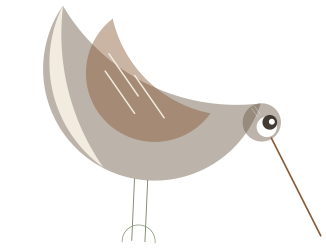

a feathered object (bird)
A game of walking, and of the feathers that places are.
the invitation
What it is
Press reveal feathers and a handful lights up across the stretch of moor you're looking at. Put your shoes on, go out, and collect as many as you can reach. Each one, as you arrive, turns out to be a particular feather — the one that spot has always been. Bring them home and they are kept in the reckoning: a flock of walks, and no two of them alike.
A feather is the same thing as a place. Every place has a name — NY 7235 5462 on British ground, 32U LB 5668 4485 anywhere else — and every name grows one particular feather, always the same one. So the moor is not a surface with feathers scattered on it; it is a surface made of feathers, invisible until you walk to one and it develops in the hand.
the doing
How to play
- Frame the moor you fancy on the map — pinch and drag to the ground you'd actually walk.
- Press reveal feathers. Icons appear at real places across the circle you can see.
- The toy starts looking for your feet the moment you touch it — your phone will ask permission once, and after that it simply knows. Walk to a feather; when you reach it, it is yours, grown right there from the ground you are standing on.
- Press centre map to jump the map back to your own dot and zoom in — scout ahead down the cleugh, then press it and you have your feet again.
- Press bring them home to keep the walk's feathers in the reckoning below.
- Turn the dial on the rim to choose which bird wears your finds — snipe, curlew, wagtail, any of the flock.
- The toy has two modes. Expedition is the walk: feet on, feathers to find and keep. Armchair is for looking without walking — tap the map to see the feather of anywhere, and plan tomorrow's walk. Tap a mode's name to switch; you only keep the feathers you actually stand on.
- Press the sheet to turn the map over: the Ordnance Survey Explorer for British ground, or the whole world for everywhere else. The feathers are the same either way.
Sending a walk to someone
Press share this walk and your walk goes out as one picture: your bird, wearing the feathers you found, and beneath her a little map of the walk — every place you stood, in its true spot, joined in the order you walked them, with a compass and a scale, and the grid references footnoted small beneath for the curious. It drops straight into a chat, no link and nothing to open. A bird and her ground, and nothing to explain.
The reckoning, and keeping it safe
Every walk you bring home is kept in the reckoning — each feather a place you have stood. It lives in your phone, in this page, between visits. To keep it truly safe — for a new phone, or a cleared browser — press download: it makes a small keepsake file. You never need to open that file yourself; just keep it somewhere. When you want your flock back, press open a reckoning and hand it the file. That is the whole of it.
the why
The moon-birds
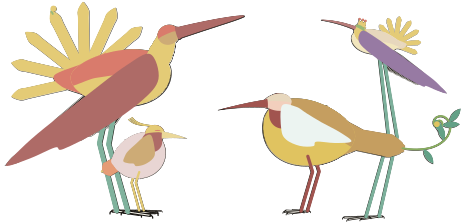
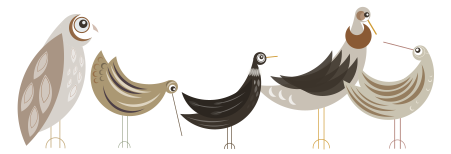
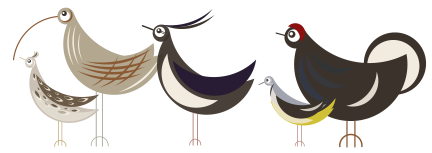
The birds are moons. Each is a crescent — a moon-shape — dressed in a few imaginary feathers and drawn by mathematics, for no better reason than that their maker can't draw a bird any other way. The flock keeps growing, from the lapwing to the barn owl, each with a field-guide page of her own: her plain facts, how she sounds, an old augury, her egg, and here and there a note from real ground.
Birds & brids
A bird is real: a species of the North Pennines, drawn and documented, with her measurements, her call and her place on the moor. A brid is the old English, and imaginary: a bird with her anatomy shuffled about — a kind of anatomical metathesis, worked from the real AVONET measurements and a good deal of daftness — so that every place has one particular brid, as it has one particular feather. If it was measured, it is a bird. If it is the wrong way round, it is a brid.
The daft name
"A feathered object (bird)" is a phrase lifted from a serious academic paper on drawing a feather by mathematics — Streit and Heidrich's A Biologically-Parameterized Feather Model. For one line the formal language curls up into a small feral poetry creature: a feathered object, bird. The whole toy lives inside that parenthesis. (The feathers themselves are grown by Feaffer, the workshop that came out of that same paper.)
The place, and the why
This is a moor in the North Pennines — the South Tyne and its tributaries, the fells above Eals, the particular ground its maker walks with the dog. The feeling it is after is the jug by the back door: the real collection of real moor-gifts, each one tied forever to the exact spot it was found. We are making a moor that never runs out of that feeling.
How a place becomes a name, what that name is worth, why there are two grids leaning a fraction of a degree against each other, and the red line where the Ordnance Survey quietly annexes France — that is all set down in the appendix, at the back of the book. Along with the feather on the far side of the Earth.
A feather is the same thing as a place.